Today, Knock is known internationally as a place of prayer and pilgrimage. But its story began quietly, on a wet August evening, when fifteen ordinary people said they witnessed an extraordinary vision at the gable wall of their parish church.
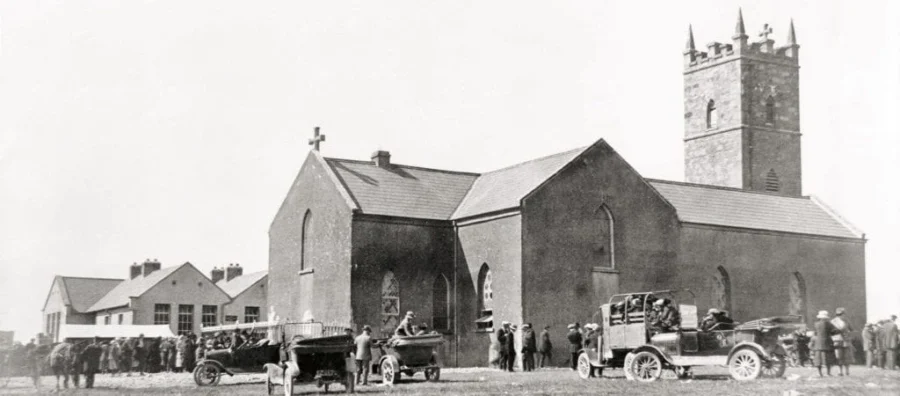
An Ordinary Day in Knock
Knock in 1879 was a small rural community in the west of Ireland. Life was shaped by farming, family, parish life and the difficult circumstances facing many people across Ireland.
The year itself was marked by hardship and uncertainty. Poor weather and the potato blight added to the concerns of communities that still carried the painful memory of the Great Famine.
On 21 August, villagers went about their ordinary work. Some gathered turf, others worked with hay and livestock, and people carried on with the familiar routines of rural life. As evening approached, heavy mist and rain settled over the village.
Nobody could have known what was about to happen.
Something Extraordinary at the Church
As evening fell, word began to spread that something unusual could be seen at the parish church.
People made their way towards the churchyard and the southern gable. There, according to the accounts given by the witnesses, a brilliant light surrounded a remarkable scene.
The figures described were Our Lady, St. Joseph and St. John the Evangelist.
At the centre was something particularly distinctive: an altar with the Lamb of God, standing before a Cross and surrounded by angels.
The witnesses described Our Lady dressed in white, with her hands and eyes raised towards heaven. St. Joseph stood to her right, while St. John the Evangelist stood to her left, appearing to hold an open book.
There was something else remarkable about the event.
There were no spoken words.
Unlike many other reported Marian apparitions, the vision at Knock was silent.
The witnesses simply watched and prayed.
Fifteen Witnesses
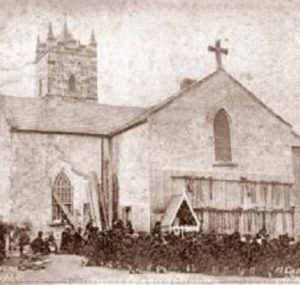
One of the most important aspects of the Knock story is the testimony of the people who said they witnessed the event.
There were fifteen official witnesses, ranging in age from five to seventy-four. They were not a single group of people from one background; they included ordinary members of the local community who later gave accounts of what they had seen.
Their testimonies became an important part of the history of Knock.
The witnesses reported remaining at the site for approximately two hours, praying the Rosary as they observed the scene.
The rain continued, yet the witnesses described the apparition itself as remaining visible.
Their accounts would soon lead to something equally important: an investigation.
The First Investigation
The Church did not simply accept the reports without examination.
In October 1879, Archbishop John MacHale of Tuam established a Commission of Enquiry to investigate the reported apparition and examine the witnesses.
The commission consisted of three principal investigators:
- Archdeacon Bartholomew Cavanagh
- Canon James Waldron
- Canon Ulick Bourke
Witness statements were recorded, and the commission examined the reliability of those who had reported seeing the vision.
At the conclusion of the investigation, the commission reported that the testimony, taken as a whole, was trustworthy and satisfactory.
A second Commission of Enquiry would take place decades later, in 1935–36, further examining the witnesses and their accounts.
This history is important because Knock is not simply remembered because of a story passed from one generation to another. The testimony of the witnesses became part of a formal ecclesiastical investigation.
From Small Village to Place of Pilgrimage
News of what had happened at Knock began to spread.
Within months, people were travelling to the village. The first organised pilgrimages began as early as 1880.
One early pilgrimage saw approximately fifty people travel from Limerick, while another group of 240 young men travelled from Cork. Later that year, more than 1,000 Irish emigrants travelled from Manchester.
The small village had begun to change.
People were no longer coming simply to see the place where an extraordinary event had been reported. They came to pray, to seek comfort, to give thanks and to ask for Our Lady’s intercession.
Knock gradually became a destination for pilgrims from Ireland and beyond.
What Makes Knock Unique?
There are many details that make the Knock account distinctive, but perhaps the most significant is the Eucharistic imagery at its centre.
The witnesses described seeing the Lamb of God on an altar, before a Cross and surrounded by angels.
The presence of the Lamb and altar gives the Knock event a particularly strong Eucharistic dimension. The Shrine itself describes this element as unique among recognised Marian apparitions.
The scene also brings together Our Lady, St. Joseph, St. John the Evangelist and the Eucharistic Lamb.
It is a silent scene, but one rich in symbolism.
And perhaps that silence is one of the reasons Knock continues to invite reflection.
Knock Through the Years
The story of Knock did not end in 1879.
The number of pilgrims continued to grow, and the site developed into an international place of Marian and Eucharistic devotion.
In 1954, during the Marian Year, Pope Pius XII blessed the Knock Shrine banner and presented it with a commemorative medal. By the end of that Marian Year, annual pilgrim numbers had exceeded one million.
In 1979, on the centenary of the apparition, Pope John Paul II visited Knock. He celebrated Mass before a huge congregation and elevated the Church of Our Lady, Queen of Ireland, to the status of a Basilica.
Decades later, in 2018, Pope Francis visited Knock Shrine during his visit to Ireland for the World Meeting of Families and spent time in silent prayer at the Apparition Chapel.
These moments helped reinforce Knock’s place within Ireland’s religious and pilgrimage heritage.
More Than a Historical Story
For many people, Knock is not simply a story belonging to the past.
It remains a place where people come to pray, reflect, give thanks and seek hope.
The original gable wall has been preserved within the Apparition Chapel, allowing visitors to pray at the location associated with the 1879 event.
That connection between place, testimony and faith is an important part of the continuing story of Knock.
The fifteen witnesses could never have known what their testimony would eventually mean to generations of pilgrims.
They simply described what they believed they had seen.
Their accounts were listened to, recorded and investigated.
And their testimony became part of the story of a place that would eventually welcome pilgrims from around the world.
Why Testimony Still Matters
This is one of the reasons stories like Knock continue to capture people’s attention.
A testimony is not simply a claim that asks someone else to believe without question. At its heart, it is a person’s account of an experience that they believe changed something in their life.
The Knock witnesses gave their testimony nearly 150 years ago.
Today, people continue to share personal stories of faith, answered prayer, extraordinary experiences and moments they believe have changed their lives.
Every testimony deserves to be approached with respect, honesty and discernment.
For MOLAP, that is why personal testimony is so important.
We believe that hearing another person’s story can encourage reflection, strengthen hope and open a deeper conversation about faith.
Knock Today
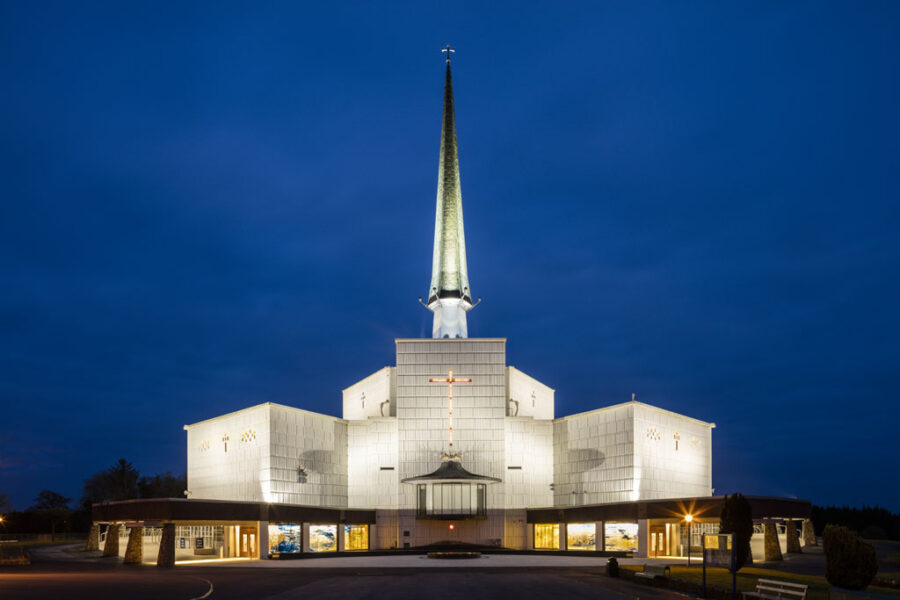
Knock has grown from a small rural village into an international Eucharistic and Marian Shrine, welcoming pilgrims and visitors from around the world.
Yet at the heart of the Shrine remains the same gable wall where, according to the witnesses, something extraordinary happened on a rainy August evening in 1879.
The story began with fifteen people.
It continued through their testimony.
It grew through the pilgrims who came seeking prayer and hope.
And today, the story continues through every person who walks through the Shrine, pauses in prayer and asks what Knock might mean for their own journey of faith.
Perhaps that is the enduring mystery of Knock.
An extraordinary story began with ordinary people — and their testimony continues to invite the world to stop, listen, pray and hope.

Discover the Story With MOLAP
MOLAP brings stories of Marian devotion, personal testimony and faith closer to communities through events, Testimonial Talks and digital presentations.
If the story of Knock has inspired you, we invite you to follow MOLAP, become a free member and join us at one of our upcoming events.
Listen to the testimony. Discover the story. Come and experience the journey for yourself.
